We spend a lot of time thinking about what learning platforms teach.
Mathematics. Languages. Physics. History.
But there is another curriculum running quietly underneath all of them.
A behavioral curriculum.
Every interaction with a learning platform teaches the learner not only something about the subject, but also something about what to do when learning becomes difficult.
What happens when you don't know the answer?
What happens when you make a mistake?
What happens when you get a terrible score?
What happens when the system tells you that you're behind?
And perhaps most importantly:
What happens in the five seconds after bad news?
That moment may matter much more than we think.
Learning has cues
Habits don't happen in isolation.
They are often triggered by cues.
A notification makes us check our phone. Walking into the kitchen makes us look in the refrigerator. Sitting down with coffee can trigger a behavior we've repeated alongside coffee hundreds of times.
Learning is not magically exempt from this.
A learner can develop associations between certain cues and certain behaviors.
Imagine this sequence:
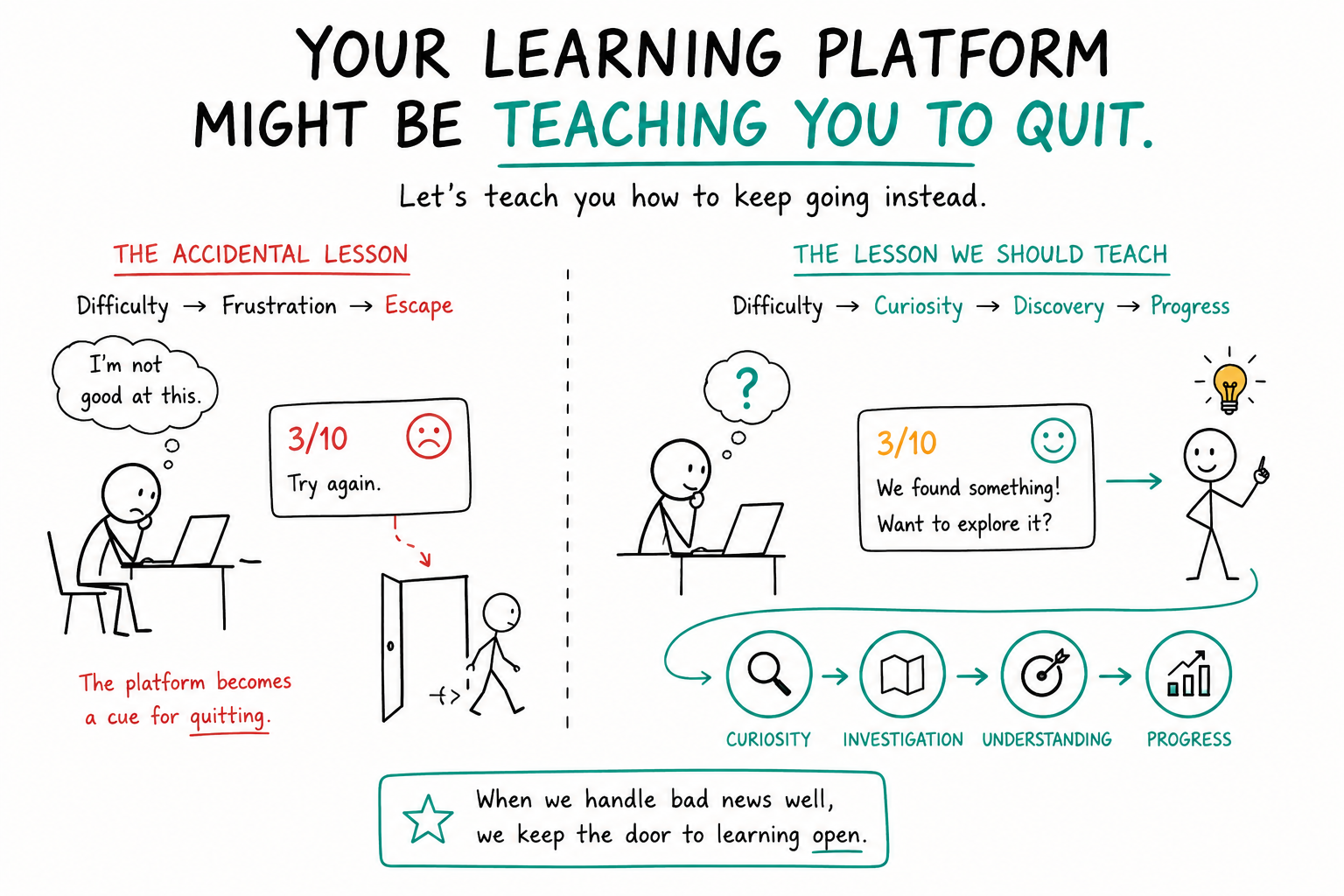
Open learning platform → difficult question → wrong answer → frustration → close platform
Repeat it often enough and something interesting can happen.
The sequence starts getting shorter.
Eventually:
Difficult question → quit
Or:
Bad score → quit
Or even:
Open learning platform → avoidance
The platform itself has become a cue.
This creates an uncomfortable possibility for educational technology:
A learning platform can accidentally become very good at teaching learners to stop learning.
The Two Curricula
Every learning system effectively teaches two things.
The first is obvious.
The academic curriculum
Fractions.
Grammar.
Newton's laws.
Programming.
History.
Whatever the learner came there to study.
But underneath it sits another curriculum.
The behavioral curriculum
What should I do when I am confused?
What should I do when I fail?
What should I do when something feels difficult?
What should I do when I don't immediately understand something?
What should I do when progress feels slow?
Traditional educational systems understandably concentrate on the first curriculum.
But the second may determine whether the learner stays around long enough to learn the first.
A system might teach mathematics perfectly while simultaneously teaching:
Difficulty means you're bad at this.
Wrong answers mean failure.
Falling behind means you've lost.
Confusion means escape.
None of those lessons appear in the syllabus.
But they can still be learned.
Sometimes the Interface Is the Problem
Consider something completely ordinary:
Score: 3/10
7 incorrect.
There is nothing factually wrong with this interface.
The learner got three questions correct.
The platform accurately reported the result.
But accuracy isn't the only question we should ask.
We should also ask:
What behavior is this screen likely to trigger next?
For a confident learner, perhaps nothing problematic happens.
For someone who already struggles with the subject, the experience can be different.
The learner sees:
3/10.
The emotional interpretation may be:
I'm terrible at this.
And the obvious escape from that unpleasant feeling is incredibly close.
Close the browser.
Switch apps.
Open TikTok.
Do literally anything else.
And suddenly something important has happened.
The learner experienced discomfort.
The learner escaped.
The discomfort disappeared.
The escape worked.
Do that repeatedly and we may accidentally strengthen exactly the behavior education is supposed to fight:
Difficulty → escape.
The Five Seconds After Failure
This is where learning platforms have an enormous design opportunity.
Imagine the same result:
3/10
But instead of ending the interaction there, the system says:
We found something.
Five of your seven mistakes seem to come from the same concept.
Fix that one thing and this exercise could look completely different.
Want to see what it is?
The score hasn't changed.
We haven't lied.
We haven't told the learner that 3/10 is secretly fantastic.
We haven't thrown confetti onto the screen.
The bad news is still bad news.
But something else has appeared alongside it:
curiosity.
And curiosity gives the learner somewhere to go.
Instead of:
Bad result → exit
we can design:
Bad result → curiosity → next action
That small difference could be enormously important.
Don't Hide Bad News
There is an obvious trap here.
If educational software becomes afraid of negative emotions, we can end up building systems that refuse to tell learners the truth.
Everything becomes:
“Amazing!”
“Great effort!”
“You're doing wonderfully!”
even when the learner clearly isn't.
That's not what I'm proposing.
Learning requires feedback.
Sometimes the feedback genuinely is:
You don't understand this yet.
The question isn't whether we should deliver bad news.
We should.
The design question is:
What should happen immediately after the bad news?
Bad news should not be a dead end.
It should create movement.
Bad News Needs a Hook
When APUOPE has to tell a learner something unpleasant, the next interaction should ideally contain something worth pursuing.
That could be curiosity.
A mystery.
A tiny challenge.
A meaningful choice.
A surprising observation.
A visible path forward.
For example:
You got this wrong.
But your answer suggests that you actually understood the first two steps.
The problem appears in step three.
Can you spot it?
Or:
4/10.
That's the bad news.
The useful news: four of those mistakes appear to have the same cause.
Let's test that theory with one question.
Or:
This topic isn't mastered yet.
But we now know exactly where things start going wrong.
Go deeper?
The learner isn't being protected from failure.
Failure is being converted into information.
And information creates a reason to continue.
APUOPE Could Treat Failure as a Diagnostic Event
This fits particularly well with what APUOPE can become.
Most learning platforms primarily ask:
Was the answer correct?
APUOPE can ask something more interesting:
What does this answer tell us about the learner?
A wrong answer isn't just 0 points.
It is evidence.
Maybe the learner understands the concept but made a calculation mistake.
Maybe they understand step one but not step two.
Maybe they memorized a rule without understanding why it works.
Maybe an earlier prerequisite is missing.
Maybe the question itself was misunderstood.
Those situations shouldn't necessarily produce the same response.
Instead of simply saying:
❌ Incorrect.
APUOPE could say:
Interesting.
This looks less like a calculation problem and more like a misunderstanding of what the question is asking.
Let's check.
Then give one carefully chosen diagnostic question.
Suddenly the platform isn't merely grading the learner.
It is investigating the learner's understanding with them.
That is a very different relationship.
BASE and GO DEEPER Can Become Behavioral Tools
This is where APUOPE's BASE and GO DEEPER concepts become especially useful.
BASE can establish where the learner actually stands.
Not:
“Here are 50 questions. Good luck.”
But:
Let's find your current position.
Then GO DEEPER can investigate what happens when understanding starts breaking down.
A mistake doesn't necessarily mean:
more questions.
It might mean:
better questions.
If several answers indicate the same weakness, APUOPE doesn't need to punish the learner with twenty repetitions.
It can say:
I think I've found the gap.
Let's test it.
Now assessment becomes exploration.
And exploration is inherently more engaging than judgment.
The System Should Detect Quitting Risk
There is another layer to this.
APUOPE doesn't necessarily have to wait until the learner actually quits.
Behavior itself can provide signals.
Imagine a learner who:
- answers several questions rapidly,
- suddenly slows down,
- gets two difficult questions wrong,
- requests multiple hints,
- changes answers repeatedly,
- and starts spending much longer on each screen.
Traditional software may simply record these as analytics.
APUOPE could interpret them as something more useful:
The probability of disengagement may be increasing.
That doesn't mean making everything easier.
It means changing the interaction.
Perhaps this is the moment to say:
Something changed.
The last few questions were clearly harder for you.
I think I know why.
Want to test my theory?
Now the system is responding not only to academic performance but to the learning process itself.
Never Reward Quitting
There is an important distinction.
We shouldn't respond to difficulty by immediately giving the learner unrelated entertainment.
Imagine:
❌ Wrong answer!
Here's a funny video.
That might keep someone on the platform.
But it doesn't necessarily strengthen learning behavior.
The engaging element should pull the learner deeper into the learning process, not away from it.
The ideal sequence isn't:
Failure → entertainment
It is:
Failure → curiosity → investigation → understanding
The reward becomes the discovery.
“Oh. That's what I was doing wrong.”
That is exactly the experience we want learners to start seeking.
Can We Change What Failure Predicts?
This may be the bigger idea.
Suppose someone's previous experience with education has repeatedly taught them:
Confusion → embarrassment
Mistake → judgment
Bad score → failure
Difficulty → frustration
Then it isn't surprising if learning itself begins producing avoidance.
But what if a learning system repeatedly creates a different sequence?
Confusion → investigation
Mistake → useful information
Bad score → clearer map
Difficulty → breakthrough
Repeated enough times, the learner's expectations may begin to change.
The objective isn't to convince them that failure feels wonderful.
It is to teach something much more realistic:
When I don't understand something, there is a process for figuring out why.
That's an extraordinarily valuable learning skill.
And unlike algebra or grammar, it transfers almost everywhere.
Maybe Persistence Should Be a Product Metric
Educational platforms measure plenty of things:
accuracy,
completion,
time spent,
questions answered,
streaks,
test scores.
But perhaps we should also measure something like:
What happens after failure?
Does the learner attempt another question?
Do they investigate the explanation?
Do they choose GO DEEPER?
Do they return to the concept?
Do they leave?
That gives us a completely different metric:
Post-Failure Continuation Rate.
Imagine two learning systems.
Platform A produces slightly better immediate test scores but 35% of learners leave after a difficult failure sequence.
Platform B produces similar scores but learners overwhelmingly continue investigating after mistakes.
Which platform is actually teaching better learning behavior?
I would argue that the second metric deserves far more attention than educational technology currently gives it.
The Desired State Is Not "No Failure"
Failure isn't the enemy.
Confusion isn't the enemy.
Difficulty isn't the enemy.
They are unavoidable parts of serious learning.
The real danger is teaching the learner the wrong response to them.
The desired state shouldn't be:
The learner never feels frustrated.
It should be:
When frustration appears, the learner knows what to do next.
That changes the role of APUOPE.
It isn't simply a system that generates tests.
It isn't even simply a system that adapts questions to someone's ability.
It can become a system designed around a more fundamental objective:
Teaching the learner how to behave when learning becomes difficult.
Because every learning platform has two curricula.
One teaches the subject.
The other teaches the learner what to do when they don't know.
And if we design that second curriculum badly, we may accidentally teach one lesson extremely well:
how to quit.
APUOPE should teach the opposite.
Difficulty discovered. Next move unlocked.